Exploring Matthew Clark's 'Ghost' Artistry: A Deep Dive into Comic Book Art Techniques
In the realm of multidisciplinary creative professionals, few names resonate with the same level of ambition and versatility as Matthew Clark, known in artistic circles as "Ghost." His work spans a broad spectrum of industries, from entertainment to consumer products and automotive design, showcasing a unique ability to translate ambitious ideas into fully realized productions. This exploration delves into the intricate artistry behind Matthew Clark's "Ghost" persona, focusing particularly on his mastery of comic book art techniques, which serve as a cornerstone of his creative output.
The Foundations of Comic Book Art Techniques in Matthew Clark's Work
Comic book art techniques are a complex blend of storytelling, visual composition, and technical skill, all of which Matthew Clark employs with remarkable precision. His approach is characterized by a meticulous attention to detail, a deep understanding of narrative flow, and an ability to evoke emotion through visual means. The foundation of his artistry lies in the seamless integration of line work, shading, and color theory, which together create dynamic and immersive panels that captivate the viewer.
Clark’s process often begins with conceptual sketches that establish the mood and tone of the piece. These initial drawings are refined through iterative stages, incorporating feedback and adjustments that enhance clarity and impact. His use of parallel structure in panel layouts ensures a rhythmic progression that guides the reader’s eye naturally across the page, maintaining engagement and reinforcing the story’s pacing.
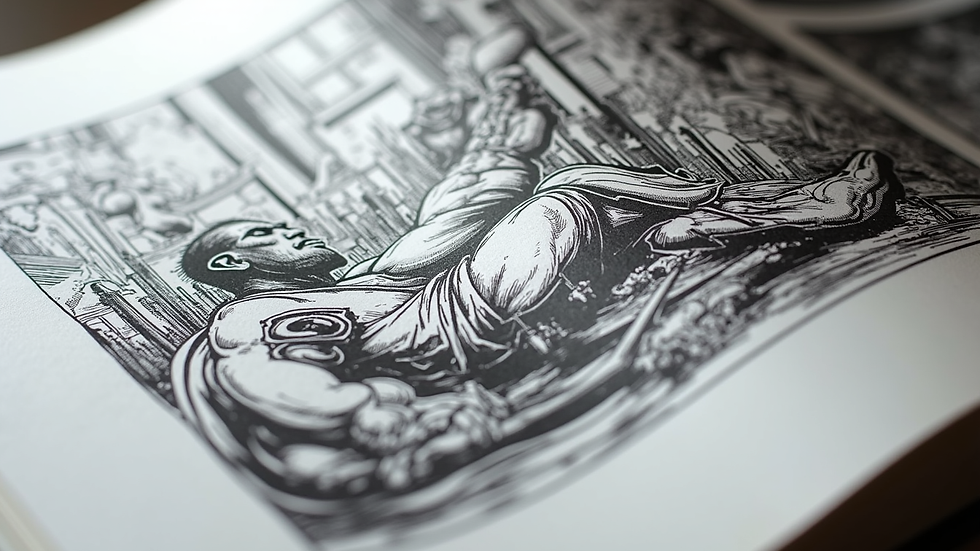
In practical terms, Clark’s comic book art techniques include the strategic use of contrast to highlight focal points, the application of cross-hatching to add texture and depth, and the careful balancing of negative space to prevent visual clutter. These elements combine to produce artwork that is not only aesthetically pleasing but also functionally effective in storytelling.
Integrating Multidisciplinary Elements with Comic Book Art Techniques
Matthew Clark’s artistry transcends traditional comic book boundaries by incorporating elements from various creative disciplines. This multidisciplinary approach enriches his work, allowing for innovative expressions that resonate across different media and industries. For instance, his experience in automotive design informs his rendering of mechanical details and dynamic motion, lending authenticity and energy to scenes involving vehicles or machinery.
Moreover, Clark’s background in consumer product design influences his attention to form and function, ensuring that every visual element serves a purpose within the narrative framework. This synthesis of disciplines is evident in his ability to craft characters and environments that feel both imaginative and grounded, striking a balance between fantasy and reality.
The integration of these diverse influences requires a sophisticated understanding of visual language and the ability to adapt comic book art techniques to suit various contexts. Clark’s work exemplifies this adaptability, demonstrating how foundational skills can be expanded and reinterpreted to meet the demands of different creative projects.

Who is Matt Clark to Sharon Newman?
In exploring the personal and professional connections that shape an artist’s journey, it is pertinent to consider the relationship between Matt Clark and Sharon Newman. While details about their association are limited, it is clear that such connections often influence creative collaboration and inspiration. Understanding these relationships provides insight into the networks that support and propel artistic innovation.
Clark’s interactions with peers and collaborators like Newman contribute to a dynamic exchange of ideas, fostering an environment where creativity can flourish. These partnerships often lead to projects that push boundaries and explore new artistic territories, reflecting the collective ambition of those involved.
Practical Applications of Matthew Clark’s Comic Book Art Techniques
For clients, brands, and filmmakers seeking to harness the power of visual storytelling, Matthew Clark’s comic book art techniques offer valuable lessons and actionable strategies. His work demonstrates the importance of:
Conceptual Clarity - Begin with strong, clear concepts that guide the entire creative process.
Iterative Refinement - Embrace feedback and continuous improvement to enhance the final product.
Narrative Cohesion - Use visual elements to support and advance the story consistently.
Technical Precision - Apply detailed line work, shading, and color thoughtfully to create depth and interest.
Cross-Disciplinary Integration - Leverage skills from various fields to enrich and diversify the artwork.
By adopting these principles, creative professionals can elevate their projects, ensuring that ideas are not only visually compelling but also strategically aligned with their goals.
The Enduring Impact of Matthew Clark’s 'Ghost' Artistry
The legacy of Matthew Clark’s "Ghost" artistry lies in its ability to inspire and influence across multiple sectors. His commitment to excellence and innovation sets a benchmark for what can be achieved when technical skill meets creative vision. As industries continue to evolve, the demand for multidisciplinary professionals who can navigate complex projects from concept to market placement grows increasingly vital.
In this context, Matthew Clark stands as a paragon of such expertise, offering a model for others to emulate. His work exemplifies how comic book art techniques, when executed with precision and integrated with broader creative disciplines, can produce compelling narratives that resonate deeply with diverse audiences.
For those interested in exploring this artistry further, the work of matthew clark "ghost" provides a rich repository of inspiration and practical insight, demonstrating the power of visual storytelling in its most refined form.
This exploration underscores the significance of mastering comic book art techniques within a multidisciplinary framework, highlighting how Matthew Clark’s "Ghost" persona continues to shape the creative landscape with ambition, skill, and visionary artistry.


Comments